| dc.contributor.advisor | Ceballos Villada, Zeneida Rocío | |
| dc.coverage.spatial | cead_-_popayán | |
| dc.creator | Narváez Zúñiga, María Del Mar | |
| dc.date.accessioned | 2023-10-23T20:23:12Z | |
| dc.date.available | 2023-10-23T20:23:12Z | |
| dc.date.created | 2023-10-18 | |
| dc.identifier.uri | https://repository.unad.edu.co/handle/10596/58200 | |
| dc.description | No aplica | |
| dc.description.abstract | El propósito del presente estudio es comprender los procesos de salud mental comunitaria en excombatientes de las FARC en el Departamento del Cauca. Se utilizó una metodología de tipo cualitativa con enfoque fenomenológico hermenéutico y con técnicas como la observación participante, rastreo de redes sociales y entrevistas a profundidad que se le realizaron a cinco miembros de la comunidad pertenecientes a las zonas del Estrecho, Caldono, Argelia, Timbío y Popayán e incluyendo a su líder general.
La información obtenida se organizó a través de tres categorías propuestas: a) Percepciones sociales sobre salud mental comunitaria b) Acciones de salud mental comunitaria, c) Participación de los actores comunitarios.
Los resultados de esta investigación reflejan la manera como la comprensión de la salud mental comunitaria transciende el campo de la salud vista desde la enfermedad, al vincularse con otros procesos que van desde lo individual a lo colectivo, pensando siempre en pro de su bienestar y calidad de vida.
Hablar de bienestar dentro de esta comunidad es hablar de satisfacción de sus necesidades básicas, pues mientras no se cumplan pilares como la salud, vivienda, educación, empleo y proyectos productivos, no es posible hablar de salud mental comunitaria, pilares que se han visto truncados por barreras sociales como la estigmatización, la inseguridad en que se encuentran expuestos y por el incumplimiento por parte del Gobierno.
Así mismo se hallan avances positivos dentro de sus acciones que aportan a su salud mental y están enfocadas en el hacer comunitario a través de distintos proyectos económicos favoreciendo por ejemplo el desarrollo a la resiliencia.
Se identifican retos frente a su proceso de reintegración a la vida civil teniendo en cuenta que la desconfianza hacia los otros persiste, principalmente hacía el Estado por la misma incertidumbre que se ha generado de la inequidad social en que se encuentran. | |
| dc.format | pdf | |
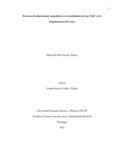
| dc.title | Procesos de salud mental comunitaria en excombatientes de las farc en el departamento del cauca | |
| dc.type | Proyecto de investigación | |
| dc.subject.keywords | Salud mental | |
| dc.subject.keywords | Salud comunitaria | |
| dc.subject.keywords | Reincorporación | |
| dc.subject.keywords | Excombatientes | |
| dc.subject.keywords | Actores participativos | |
| dc.description.abstractenglish | The purpose of this study is to understand the processes of community mental health in excombatants of the FARC in the Department of Cauca. A qualitative methodology was used with a hermeneutic phenomenological approach and with techniques such as participant observation, social network tracking and in-depth interviews that were carried out with five members of the community belonging to the Strait, Caldono, Argelia, Timbío and Popayán areas and including their general leader.
The information obtained was organized through three proposed categories: a) Social perceptions on community mental health b) Community mental health actions, c) Participation of community actors.
The results of this research reflect the way in which the understanding of community mental health transcends the field of health seen from the disease, by linking with other processes that go from the individual to the collective, always thinking in favor of their well-being and quality of life. Talking about well-being within this community is talking about meeting their basic needs, because until pillars such as health, housing, education, employment and productive projects are met, it is not possible to talk about community mental health. Pillars that have been truncated by social barriers such as stigmatization, the insecurity in which they are exposed and by non-compliance by the Government.
Likewise, there are positive advances in their actions that contribute to their mental health and are focused on community work through different economic projects, favoring, for example, the development of resilience.
Challenges are identified regarding their process of reintegration into civil life, taking into account that distrust towards others persists, mainly towards the State due to the same uncertainty that has been generated by the social inequity in which they find themselves. | |
| dc.subject.category | Investigación | |