| dc.contributor.advisor | Munévar García, Pablo Alexander | |
| dc.coverage.spatial | cead_-_josé_celestino_mutis | |
| dc.creator | Samper Ortegón, Luis Fernando | |
| dc.date.accessioned | 2022-10-11T19:28:27Z | |
| dc.date.available | 2022-10-11T19:28:27Z | |
| dc.date.created | 2022-10-05 | |
| dc.identifier.uri | https://repository.unad.edu.co/handle/10596/51667 | |
| dc.description.abstract | La presente investigación es el resultado de un estudio donde se identificaron elementos coincidentes que, desde la experiencia de usuario, resultan comunes en el diseño de Objetos virtuales y que fortalecen el aprendizaje profundo en los estudiantes de las Diplomaturas Apropiación de TIC en Escenarios Inclusivos, e-Mediador en AVA y Gestor de curso en AVA del Programa Formación de Formadores de la Escuela de Ciencias de la Educación de la Universidad Nacional Abierta y a Distancia. Se realizó la consulta de diversos autores para definir cada una de las categorías (Experiencia de usuario, Aprendizaje profundo y Objetos virtuales), con base en ello, se definió un enfoque mixto para la investigación donde se plantean tres preguntas cualitativas y doce preguntas cuantitativas en una encuesta online de tipo analítico retrospectivo. El análisis cuantitativo se desarrolló por medio del software de IBM SPSS Statistics, encontrando una experiencia de usuario positiva al interactuar con los Objetos virtuales dispuestos teniendo en cuenta, entre otros, seis elementos de la Experiencia de Usuario (UX) propuestas por Morville, P (Junio 21, 2004), “Útil, Usable, Deseable, Encontrable, Accesible y Creíble”. Para el análisis cualitativo se hizo uso del software ATLAS. Ti, donde de acuerdo con el enfoque profundo del aprendizaje, se identificó que para la mayoría de los estudiantes los Objetos virtuales resultaron comprensibles, facilitaron su proceso de aprendizaje de acuerdo con sus expectativas, y estuvieron alineados con sus emociones, necesidades y contextos de desempeño laboral. | |
| dc.format | pdf | |
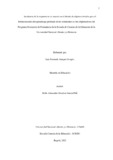
| dc.title | Incidencia de la experiencia de usuario en el diseño de objetos virtuales para el fortalecimiento del aprendizaje profundo de los estudiantes de tres Diplomaturas del Programa Formación de Formadores de la Escuela de Ciencias de la Educación de la Universidad Nacional Abierta y a Distancia | |
| dc.type | Proyecto aplicado | |
| dc.subject.keywords | Experiencia de usuario, Aprendizaje profundo, Objetos virtuales | |
| dc.description.abstractenglish | This investigation is the result of a study where coincident elements were identified that, from the user experience, are common in the design of virtual objects and that strengthen deep learning in the students of the Diplomas Apropiación de TIC en escenarios inclusivos, e-Mediador en AVA and Gestor de curso en AVA of the Formación de Formadores Program of the School of Educational Sciences at the Universidad Nacional Abierta y a Distancia - UNAD. Various authors were consulted to define each of the categories (User Experience, Deep Learning and Virtual Objects). Based on this, a mixed approach was defined for the research, where three qualitative questions and twelve quantitative questions were posed in an online retrospective analytical survey. The quantitative analysis was developed through the IBM SPSS Statistics software, finding a positive user experience when interacting with the Virtual Objects considering six elements of the User Experience (UX) proposed by Morville, P ( June 21, 2004), “Useful, Usable, Desirable, Findable, Accessible and Credible”. For the qualitative analysis, the software ATLAS Ti was used. According to the deep learning approach, it was identified that for most of the students the virtual objects were understandable, facilitated their learning process according to their expectations, and were aligned with their emotions, needs and work performance contexts. | |
| dc.subject.category | Educación | |
| dc.subject.category | Experiencia de usuario | |
| dc.subject.category | Usabilidad | |